The FernGully Fantasy
Recently I was in my kitchen cutting up one of those plastic soda rings from the mini Cokes I've started buying after years of not drinking soda.
I wondered if it was worth doing anymore. I'm a member of the “dish soap saves ducks” generation. Among those that believed that, if you stop using certain kinds of hairspray, the hole in the ozone layer would close up. I was indelibly shaped by the movie, FernGully: The Last Rainforest.
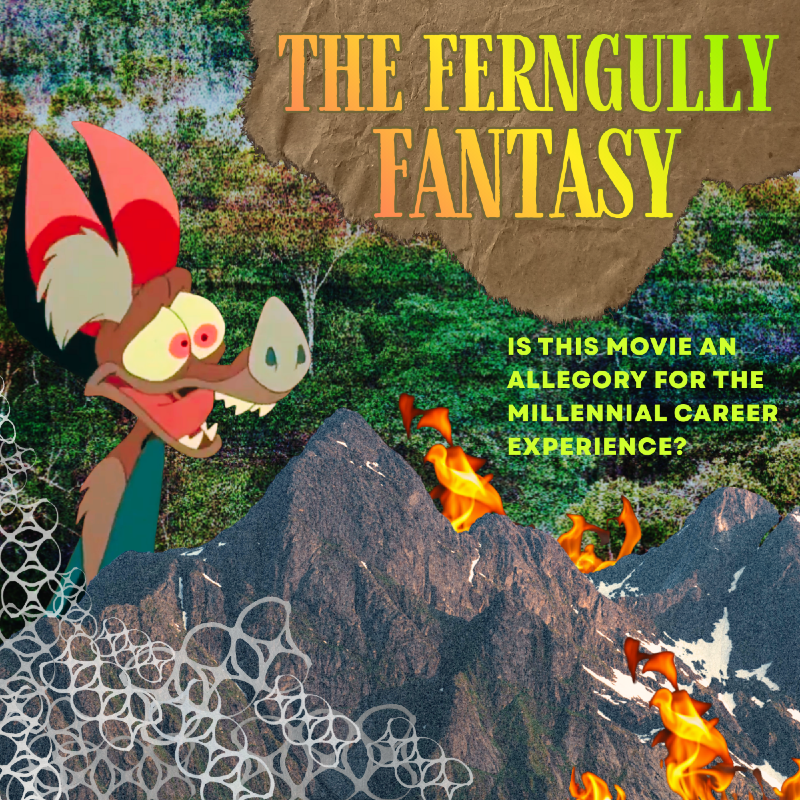
For those unfamiliar, FernGully is a movie about fairies who live in a rainforest put at risk by loggers and Hexxus, an evil, but suppressed, villain set on destruction. A curious fairy named Crysta explores the forest beyond her home and encounters a hilarious bat named…Batty, and saves the life of a human who is about to be crushed by a falling tree by shrinking him to fairy size. As they seek a solution to return Zak to his full human form, they realize that he had inadvertently caused the release of Hexxus, setting in motion their imminent demise. Together, fairies, the tiny human, and bat use magic and ingenuity to overcome the evil forces and restore what’s good in the world by planting seeds that will sprout and replenish the rainforest paradise.
But this is not about 1990s cartoon nostalgia. This is a post about millennial careers. I'm confident I would never have made this particular connection had I not been standing in my kitchen reeling from disappointment in the realization that the hope I had for what it would take to save the planet, the animals, and the rainforest feels so misguided and naive in 2026.
As doom thinking goes, one dark thought led to another and I realized that those of us who had identified with that spunky little fairy have had the world upend and contradict our expectations time and time again, and that our careers have also played out like FernGully (with the happy ending TBD).
You see, I feel like I had such a “right-timed” life for so many years. I feel like I was born into a place, a family, and circumstances that anyone would feel blessed to have. As I grew up and became more conscious of the world around me, it felt like there was such positive momentum where opportunities were increasing and prosperity expanding.
It felt true and possible that if we (millennials) did well in school and went to college, we’d get a good job. And from there, if we worked hard, we’d advance. We’d have success and fulfillment. We could make a difference. The world was our rainforest.
Millennials possessed optimism and walked into college and post-graduation careers with belief in the system. What we didn't realize was that there was darkness lurking. Evil, suppressed, but at the ready if released, to dramatically change the dynamics of the working world. As we aged into our 30s, it became clear there were forces building, optimizing for age old (money) and new (data, rapid scale) priorities. Our Hexxus gained strength by feeding on our productivity, ambition, and tech adoption.
Like Crysta, we felt comfortable in our environment, but also curious to test the boundaries, to explore, and to see what else might be available. In order to have more, we had to perform, to smile, to play the game. Early on, it seemed like our collective efforts would pay off.
Inevitably, there were Zaks (though in our case, often more tenured colleagues). These counterparts (bosses, executives) lacked self-awareness and hadn’t reflected on our experience. They had been lackadaisical in their own approach to work without suffering consequences, because things had always worked out. Momentum had carried them forward, and here we were, ready to pick up their slack. We saved them and figured out how to fix whatever wasn’t working as they continued to expect us to fall in line, cheer them on, and reciprocate their enthusiasm. We pushed for change, providing ample evidence but they were often stuck too deep, complicit participants not understanding how they needed to evolve.
As our environment shifted and we reacted to the pendulums (WFH to RTO, hiring booms to layoff busts, AI obsession paired with job market uncertainty). Our resolve wavered, and our confidence in the system weakened. Like Crysta, we felt betrayed. As a result, we’ve run away. We’ve leaned out, taken time off, built for ourselves, and invested more in the 5-9 rather than the 9-5.
We now recognize the dynamics between employers and employees and understand the system. The one we’re expected to continue to support. The one that had served so many before and may break so many that follow. We see the people who want to take our power, our potential, and siphon it into their wealth. In navigating the challenges of the Great Recession, the pandemic, and the transition from tech-enabled work to tech-dependent existence, we feel deeply how the system is holding us and future generations captive. Unfortunately, it’s working as intended.
The forest was a resource for cartoon loggers. They were going to extract every last ounce of value. We, millennials, have come to understand that work is also about extraction. That our time, energy, and productivity were the output, and that those outputs are expected to increase, to get faster, more efficient, more profitable. We see how hard it is to succeed without extracting from ourselves the effort that benefits those in power. If we don’t, our livelihoods are at risk. We are not necessarily evil ourselves, but we are incentivized to operate within the machine, to be compliant, in order to survive. We became their agents of extraction.
Now, as we enter middle age (eek, really?), we are facing the consequences. We have fought the machine, but the machine appears to be winning. Burnout, careers derailed by layoffs, fewer jobs and more applicants, longer, more complicated hiring processes, and more intense pressure to perform, are the refrains we vent about to one another. And we don’t have clever fairies or a bat with Robin Williams’ raw humanity to save us.
We have to work together to disable the parts of the machine that wreak havoc in our hearts and minds and damage our careers. We don’t have to fuel what they say is inevitable. We can step into movements and away from the status quo. We can choose what matters, but we must make those choices and accept those risks. We have many years left in our careers. We’ve already given everything we need to Hexxus. It’s time for us to plant the seeds. What we choose to do, to build, and to share will shape not only the rest of our careers, but those of the next generation. Let’s not leave them where we found ourselves.
In the meantime, you’ll find me cutting up those soda rings.